D28 Series 3D Welding Table for Efficient and Repeatable Setups
The D28 Series 3D Welding Table for Efficient and Repeatable Setups is a heavy‑modular 3D welding fixturing solution. Featuring Φ28 mm
100 mm grid holes, five‑sided bored surfaces and plasma‑nitrided
surface treatment, it realizes fast and repeatable fixture setups
for batch welding. It supports heavy‑load working and is
interchangeable with international D28‑standard fixtures for
heavy‑duty fabrication and robotic welding stations.


D28 Series 3D Welding Table Parameters
| Item | Technical Specification |
|---|
| System Hole Diameter | Φ28 mm, H7 tolerance |
| Hole Grid Pitch | 100 mm×100 mm, hole position accuracy ±0.05 mm |
| Bored Surface | 5‑sided boring (top surface + 4 side surfaces), supports
multi‑angle clamping in 3D space |
| Table Flatness | Standard: ≤0.1 mm / 1000 mm; Grade 0 precision: ≤0.05 mm/m |
| Optional Material | Q355/Q345 high‑strength steel plate / HT300 gray cast iron |
| Table Thickness | Standard 25 mm, thickened version optional for heavy‑duty
application |
| Surface Treatment | Plasma nitriding, hardness HV550‑900, anti‑spatter, wear‑resistant
and rust‑proof |
| Load Capacity | Static load: 5‑10 tons; Dynamic welding load: 2 tons |
| Matching Fasteners & Fixtures | M20 locking bolts, Φ28 positioning pins, complete D28 fixture set
(angle blocks, V‑blocks, clamps, height blocks, etc.) |
| Standard Table Sizes | 1000×1000 mm / 1500×2000 mm / 2000×3000 mm, custom large spliced
tabletop available |
| Working Height | 650‑800 mm (customizable), support legs with horizontal leveling
feet |
Product Advantages
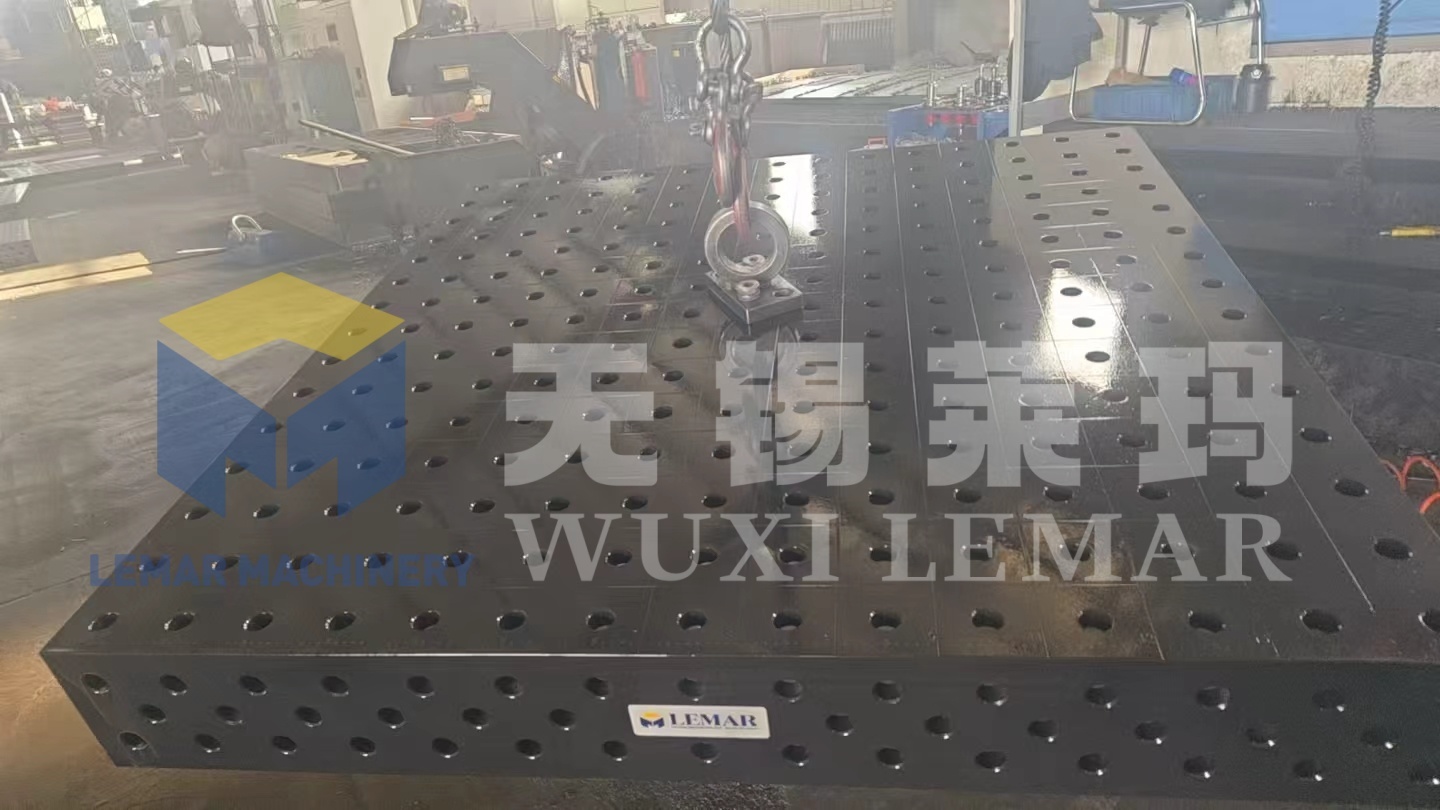
- 3D grid hole system: The tabletop and all four sides have standard Φ 28 holes.
Fixtures, positioning blocks, and clamps can be quickly installed
at any position in the X/Y/Z directions without the need for
customized special tooling molds.
- Repeatable: The hole position error is controlled within ± 0.05 mm. When
producing the same product, the previous fixture position can be
directly restored next time to ensure that the size of each batch
of workpieces is consistent and reduce repeated measurement and
machine adjustment.
- Efficient switching: Quick disassembly positioning pin, locking bolt, replacement of
different workpieces, fixture adjustment can be completed in a few
minutes, greatly reducing downtime for mold replacement, suitable
for multi variety and small batch production.
- Benchmark platform: It can also serve as a benchmark for assembly and dimensional
inspection.
Common Faults
Problem 1: The accuracy of the tabletop deteriorates after using it
for a period of time
Reason: No stress relief and aging treatment was performed; Long term
overloading; Ground subsidence; Strike the tabletop vigorously.
Solution: Re CNC milling to repair flatness; Do not strike or cut directly
on the table.
Problem 2: Sliding thread and damaged hole of locking bolt
Reason: Excessive torque, violent tightening; There are welding slag and
iron filings in the hole that have not been cleaned.
Solution: Clean the iron filings in the hole before each installation; Lock
with a torque of 80-100N * m; Damaged holes can be repaired with
inserts.
Problem 3: Welding slag sticking to the tabletop
Solution: Nitriding layer can reduce adhesion, but it cannot completely
eliminate it; Do not use a hammer to strike the welding slag, as it
will damage the nitride layer; Use a copper shovel to clean.
Problem 4: Misalignment of the splicing table
Reason: No splicing positioning pin was used; There is no overall leveling
after splicing.
Question 5: Misunderstanding that D28 is suitable for very small
parts
The hole spacing of D28 welding table is 100mm, and the positioning
accuracy of small hole parts is not as good as D16 (50mm hole
spacing), so D16 welding table is preferred for small parts.
FAQ
Q: Can I use existing Siegmund/Demmeler fixtures on your D28 table?
A: Yes, our D28 hole system is fully interchangeable with
international standard D28 fixtures.
Q: What is the recommended tightening torque for locking bolts?
A: 80‑100 N*m. Do not over‑tighten to avoid thread damage.
Q: How often should I re‑level the table?
A: Check level every 3‑6 months, especially if workshop floor has
settlement.
Q: Can multiple D28 welding tables be spliced for extra‑large
workpieces?
A: Yes, we supply special splicing locating pins for alignment.
Whole assembly needs re‑leveling after splicing.
Q: What documents will you provide for export?
A: CE certificate, material certificate, inspection report, packing
list, commercial invoice, and outgoing inspection video on request.
Experience stable, repeatable welding fixturing with the D28 Series
3D Welding Table for Efficient and Repeatable Setups.
Send us your requirements and we will provide you with the
best‑suited solution.
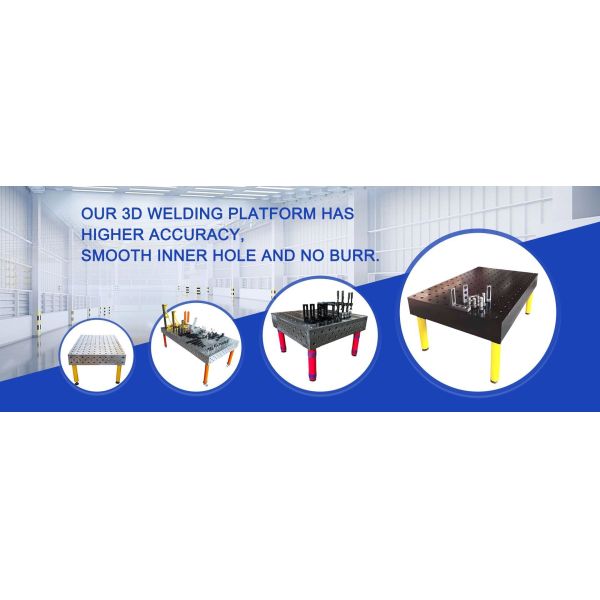

 Modular fabrication tables for precise welding and assembly work

