This testing machine is mainly suitable for testing the mechanical
properties of materials such as rubber, plastic profiles, plastic
pipes, plates, sheets, films, wires and cables, waterproof rolls,
metal wires, etc. in high or low temperature environments, such as
tension, compression, bending, peeling, tearing, and shear
resistance; Extremely convenient for users to carry out research
and development, quality control work, it is an ideal testing
instrument for industrial and mining enterprises, commercial
inspection and arbitration, scientific research units, colleges and
universities, engineering quality and other departments.
The instrument consists of the main body of the tensile testing
machine, fixtures, and a movable high and low temperature test
chamber. The main body of the tensile machine adopts a complete set
of imported digital AC servo systems and a high rigidity frame
structure. The high and low temperature test chamber adopts a
double‑layer insulated glass door, which is convenient for users to
observe the test situation. It adopts a full stainless steel frame
and inner liner, which is not only aesthetically pleasing but also
has strong corrosion resistance. The instrument has a novel design,
high accuracy, low noise, and convenient operation
3, Main parameters of the equipment:
(1) Technical parameters of tensile testing machine: (Party B
prepares the tensile testing machine themselves)
Capacity selection: 10, 20, 50, 100, 200, 500, 1000N
Capacity selection: Generally, the maximum force of specimen
failure is about 3‑10 times the value of the selected capacity
Unit selection: g, kg, N, KN, LB (available in international
standard system, metric system, and imperial system, can be
switched and used independently)
Display device: fully computer‑controlled (can freely create report
data required by customers)
Load decomposition degree: 1/100000
Test speed: 0.1~500mm/min (can be set arbitrarily on the computer)
Test itinerary: 400, 500, (can be increased according to customer
requirements)
Test width: 40cm (can be widened according to customer
requirements)
Machine testing space: (L) × W × H) 40 × forty × 70cm
Power system: servo motor+drive
Transmission method: high‑precision ball screw
Machine size: Main unit (L × W × H) 1200 × six hundred × 1500cm
Power supply: 1 Å, AC220V, 50‑60Hz
Fixture: Customized one set of tension and compression test
fixtures according to customer product requirements
(2) High and low temperature box section
Part 1: Overall Overview of System Composition
The system consists of the following parts:
The function of the test chamber is to provide a constant high and
low temperature, alternating high and low temperature testing
environment; Including refrigeration system, heating system, air
duct system, control system, system safety protection device, etc;
Part 2: Main technical indicators of the test chamber
Studio size: 900 ×600× 400mm deep × wide × High;
Note: The outer width shall not exceed 700mm and the height shall
not exceed 800mm
Temperature range: ‑60 ℃ to+150 ℃;
Temperature fluctuation: ≤ ± 0.5 ℃;
Temperature uniformity: ≤ ± 1 ℃;
Temperature deviation: ≤ ± 2 ℃;
Temperature rise and fall rate:
From+20 to ‑40 ℃, approximately 60 minutes
From+20 to 100 ℃, approximately 40 minutes
The above indicators were tested and measured under ambient
temperature ≤ 25 ℃, normal pressure, no‑load, and no load
conditions, within a space of 1/6 of the inner wall of the box;
Power: approximately 3.0Kw;
Power supply: 220V ± 10% V; 50Hz;
Meet relevant standards and test methods:
GB/T2423.22‑87Nb GJB1032‑90 MIL‑STD‑2164/(E/C)
GB/T2423.4‑93 GB/T2423.34‑86 GJB150.9‑86.
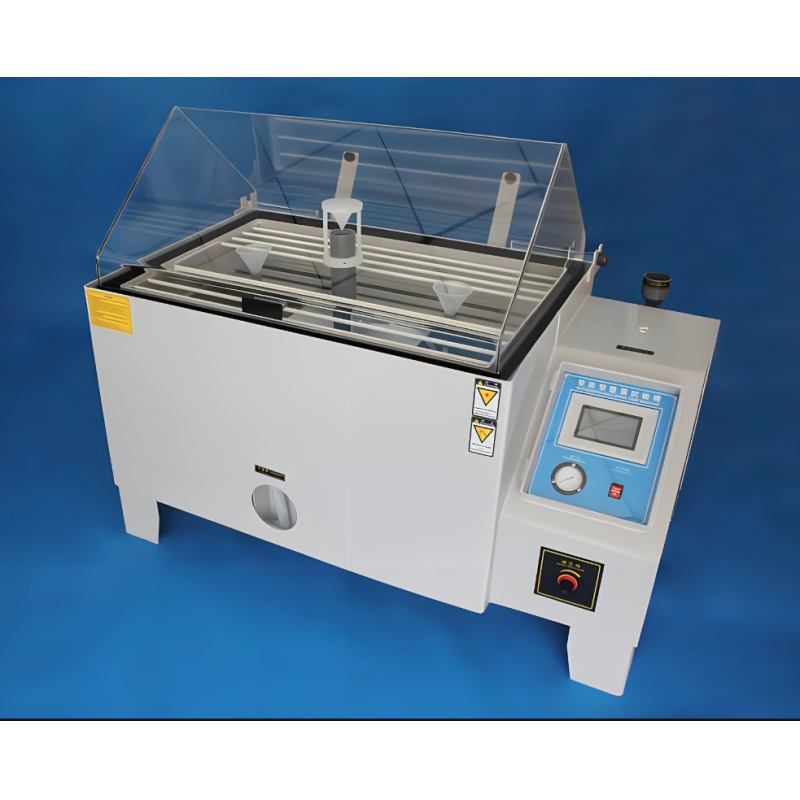
Name: Salt spray corrosion testing machine
Internal size: 1200×1000×500 (L×W×H)mm
External size: 1860×1260×1200(L×W×H)mm
Power supply: 220V single‑phase 2KW 50HZ
The hardware dedicated salt spray corrosion testing machine is a
type of test that artificially simulates a salt spray environment.
Compared with exposure tests under atmospheric conditions, it has
significant advantages: the corrosion environment can be
controlled,
Good environmental reproducibility; The experimental time has been
significantly shortened; It has saved a lot of manpower, financial
resources, and material resources.
Its development and promotion are both rapid. It has evolved from
the initial simple neutral salt spray test to various forms such as
acetate spray test, salt accelerated acetate spray test, and
alternating salt spray test.
The salt spray test chamber utilizes saline or acidic saline
solutions,
Under certain temperature and relative humidity conditions, the
material is subjected to
Or accelerate corrosion of the product,
Reproduce the degree of damage suffered by materials or products
within a certain time range.
The device can be used for
Assess the ability of materials and their protective layers to
resist salt spray corrosion,
And compare the process quality of similar protective layers,
It can also be used to test
The ability of certain nuclear products to resist salt spray
corrosion.
Salt spray test reference standard:
GB/T2423.17‑2008, GB/T 2423.18‑2000, GB/T10125‑1997, GB/T10587‑2006
GB10593.2‑1990, GB/T1765‑1979, GB/T1771‑2007
GB/T12967.3‑2008, GB/T5170.8‑2008
And equivalent relevant standards such as IEC, MIL, DIN, ASTM, etc
a: Box material: The internal and external boxes of this machine
are made of A‑grade gray PVC (5mm thick) imported from Germany,
which is resistant to high temperature, high humidity and high
corrosion. It is welded with advanced three‑dimensional
reinforcement technology produced by ring tape. The structure is
strong, solid, never deformed, gorgeous and elegant, and is
suitable for various test specifications such as brine spray,
copper acetate, etc.
b: Test solution supplement bottle: Hidden integrated test solution
supplement bottle, easy to clean and easy to operate.
c: Pressure saturation bucket: Made of A‑grade gray PVC material
imported from Germany, with exquisite tank shaped structure design,
resistant to high temperature, high humidity, high pressure, high
corrosion, and never rusting, it solves the problem of long‑term
rusting of stainless steel materials. There has been a cross
generational progress in design.
d: Laboratory storage rack: Made of German imported A‑grade gray
PVC material, finely designed as a "V" shaped strip, paired with an
"O" shaped strip with a carbon fiber diameter of 10mm, to ensure
that the tested product can be adjusted freely from an angle of 15
° ‑30 ° The test sample holder adopts a flat indexing type, which
can adjust the angle arbitrarily. The fog is evenly distributed on
all sides, and the fog is completely consistent. The test results
are accurate, and the number of test samples placed is large.
e: Laboratory top cover: Made of 8mm thick high toughness
transparent acrylic (imported) plate, designed as a 100 degree
ridge transparent top cover using physical bending method. The
remaining mist and dew droplets on the top cover slide along the
cover wall into the sealing groove to prevent them from dripping
onto the tested product.
f: With advanced functions such as self detection and self
detection, it is an excellent choice for you to achieve twice the
result with half the effort.
g: Fully digital circuit design, accurate temperature control, use
of high‑quality imported electrical materials, reasonable wiring
design, long service life, and complete testing functions.
h: Equipped with automatic/manual water filling function, it can
automatically replenish the water level without interrupting the
test when the water level is insufficient.
i: It has a power outage time memory function, which allows the
remaining test work to be completed according to the original
timing after an incoming call. It is equipped with dual over
temperature protection and insufficient water level warning to
ensure safe use.
j: The fog sealing groove uses an environmentally friendly water
sealing method to prevent the leakage of fog.
k: The spray tower adopts a conical disperser, which has the
functions of guiding fog, adjusting fog volume and even fog
falling.
l: The instrument adopts an ergonomic design, with a beautiful
appearance and easy operation. When it is finished, a buzzer will
sound an alarm.
Operate and set according to JIS, ASTM, CNS, and GB standard
parameters.
A Salt water spray test; NSS, ACSS.
Pressure air bucket: 47 ℃± 1 ℃.
Corrosion resistance test: CASS.
Pressure air drum: 63 ℃± 1 ℃.
c: Air supply system: The air pressure is adjusted in two stages of
1Kg/cm2. A section is large
Slightly adjust 2Kg/cm2, use imported air filter with drainage
function. The second stage is a precision adjustment of 1Kg/cm2,
with a 1/4 pressure gauge that displays precision and accuracy.
The Bernoulli principle absorbs saltwater and then atomizes it,
with a uniform degree of atomization and no obstruction of
crystallization
This phenomenon can ensure continuous testing.
B The nozzle is made of tempered glass, which can adjust the size
of spray volume and spray angle
The Crystal Crystal Glass Mouth (PYREX) ensures no crystal blockage
for 10000 hours.
C The spray amount is 1~2ml/h adjustable (ml/80cm2/h, the standard
requires 16 small tests
When calculating the average quantity. The measuring cylinder
adopts embedded installation, with a beautiful and neat appearance,
Easy to operate and observe, reducing instrument installation
space.
Adopting direct heating method, the heating speed is fast and the
standby time is reduced. When the temperature reaches, it
automatically switches to a constant temperature state, with
precise temperature and low power consumption. Pure titanium
heating tube, resistant to acid and alkali corrosion, with an ultra
long service life.
Adopting Freescale 32‑bit automotive ultra high speed processor,
with stable and reliable performance.
Adopting LCD digital display tubes, user‑friendly interface design,
and winning the national second special project, all parameters are
clear at a glance.
Low water level and over temperature alarm, equipped with multiple
over temperature protection to ensure safe use!
Adopting pure silver contact relay, with a lifespan of 5000000
times.
Timer: Adjustable 0.1S‑999999hr. The required time for the
experiment can be set arbitrarily, and it will automatically stop
at the end.
The fully automatic control mode and manual mode can be freely
selected, greatly improving the accuracy of the experiment!
PID temperature control is equipped with precise calibration mode,
with an error of+‑0.5, making it convenient for calibration and
measurement

 Ultraviolet Accelerated Aging Test Chamber

